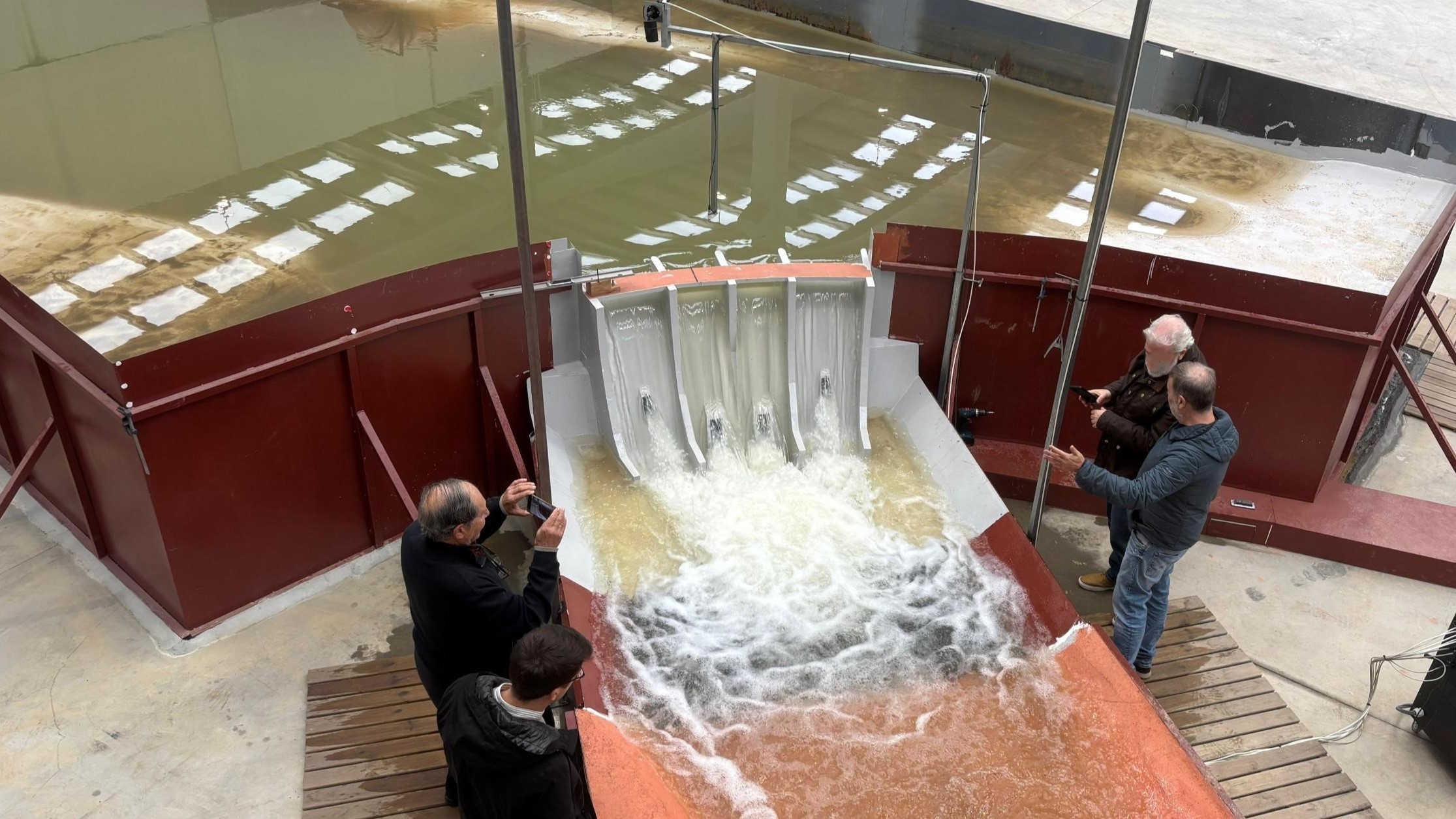
Physical models make it easier to understand projects once water starts flowing through them. These scale models validate the initial assumptions, which may first be defined theoretically or by means of numerical models (CFD), so seeing the model in operation provides a very intuitive view of the effect of a flood event.
AIN active SLU has expanded the facilities devoted to its hydraulics laboratory to accommodate new contracts for reduced dam models, not only for the Spanish market, but also for the American continent.
This week a new inspection visit was carried out to the 1:50 scale model by the engineering team and the owner of this dam. The dam is a concrete arch‑gravity structure with a central arch of approximately 200 metres radius and a crest length of more than 300 metres, characterised by a central spillway and lateral spillways. The main spillway has a fixed crest, with two central bays separated by a central pier and a Bradley‑type profile, while the lateral spillway also has two fixed‑crest bays with a crest level higher than that of the central spillway. The dam also includes two bottom outlets and two mid‑level outlets, and the flow is returned to the river channel through a stilling basin.
The experimental process requires calibration of the model, in our case always cross‑checked against numerical models. The objectives of this model include verifying freeboards and flow velocities during a flood through the spillway, assessing the performance of the bottom outlets, and checking the hydraulic jump downstream of the stilling basin and its impact on the river banks.